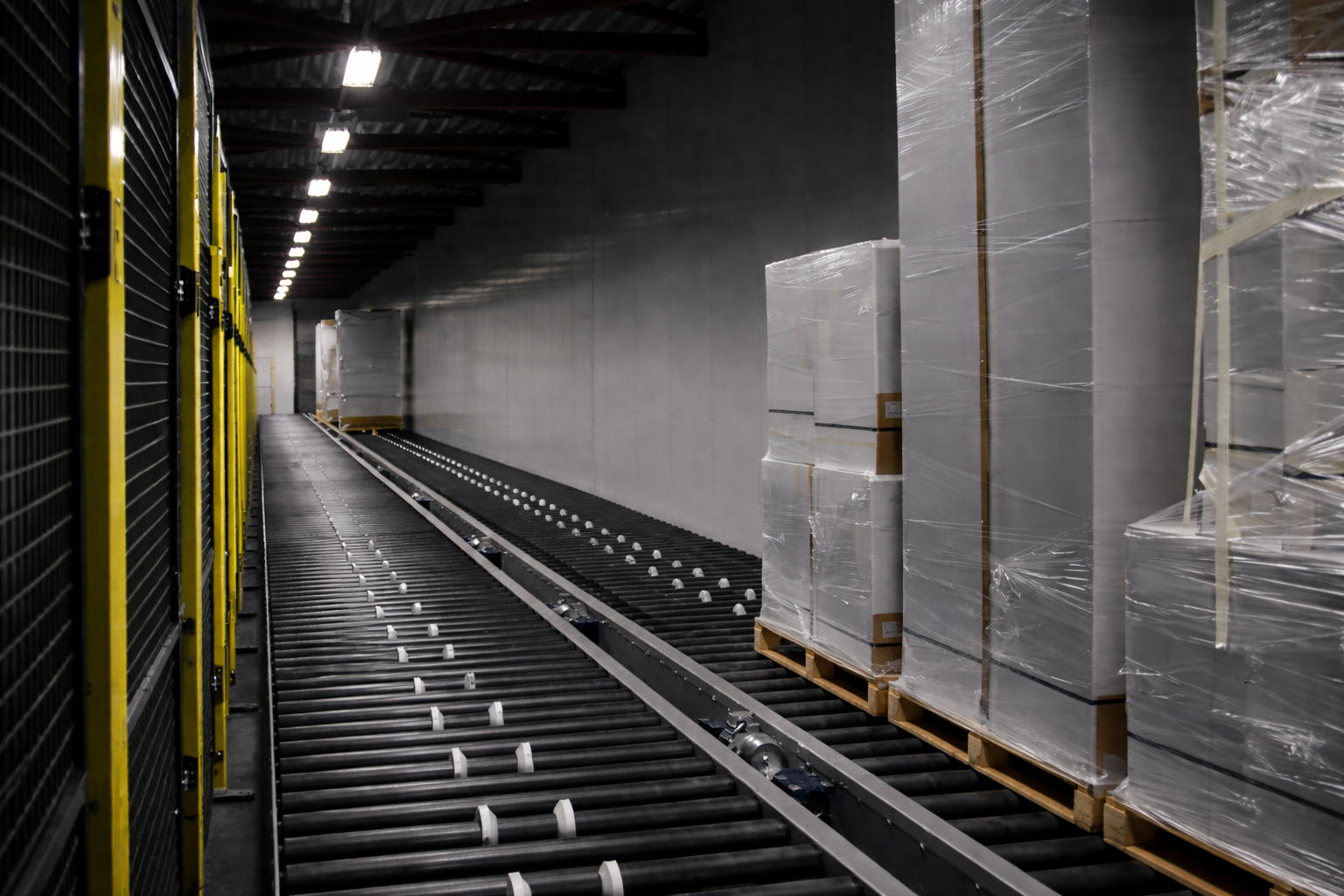
Industrial roller conveyors for boxes, pallets and unit loads
Q-System roller conveyors are engineered to ensure stable material flow and reliable transport across production, warehouse and internal logistics environments, supporting everything from light handling to heavy pallet transport.
Roller conveyors for heavy loads
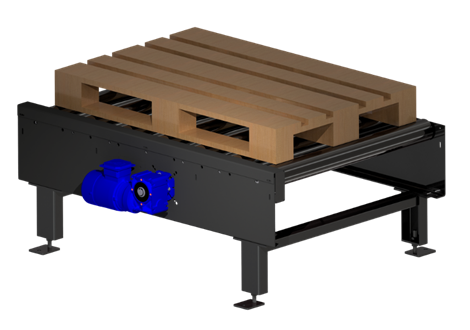
Roller conveyors for heavy loads are used for transport of pallets and heavy unit loads in industrial environments where high load capacity, controlled movement and operational reliability are required. These systems are typically designed for loads up to 1500 kg per meter, depending on pallet type, load distribution and conveyor configuration.
They are commonly used in applications where:
- Pallets must be transported continuously through the system
- The conveyor operates under high and consistent load
- Controlled and driven transport is required
- The system is part of an automated material handling setup
From a technical perspective, heavy-duty roller conveyors are typically configured with:
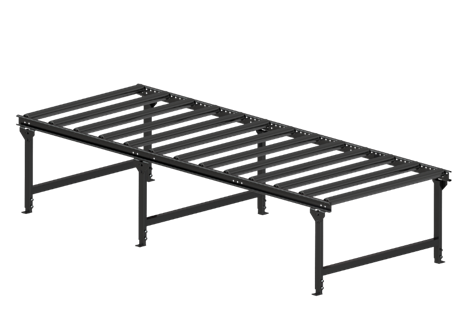
- Roller diameters around Ø89 mm in heavy steel construction
- Center distances typically between 150-200 mm
- Conveyor width adapted to pallet formats
- Modular sections (typically around 1500-2000 mm)
- Chain-driven transmission for stable and controlled movement
Depending on the application, solutions may include:
- Chain-driven roller conveyors for pallets transport
- Driven infeed and outfeed sections
- Integration with transfer units and system modules
- Configurations adapted to pallet handling and system flow
Heavy-duty roller conveyors are widely used in pallet handling systems, production lines and warehouse environments where reliability, load stability and consistent transport performance are critical.
.png?mw=470&rev=e86cadb4-2631-410b-83c6-07909e42f2c0&hash=FCC4DB6D3BD3B5C18CF4B5355FFAD5F3)
Roller conveyors for medium-heavy loads
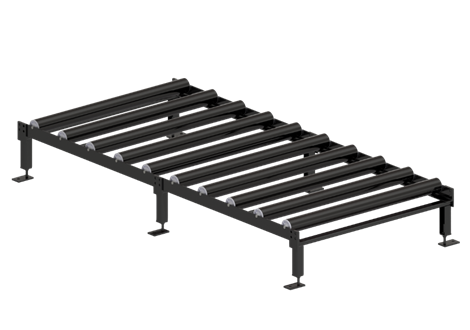
Roller conveyors for medium loads are used for transport of unit loads, boxes, pallets and products in industrial environments, where stable and reliable internal transport is required. These systems are typically designed for loads of up to 1000 kg per meter, depending on product type, support conditions and conveyor configuration.
They are commonly used in applications where:
- Products must be transported continuously between process steps
- The conveyor is part of daily production or logistics flow
- Both manual and driven transport solutions are required
- The system must support consistent and repeatable operation
From technical perspective, medium roller conveyors are typically configured with:
- Roller diameters around Ø70 mm
- Center distances typically between 100-200 mm
- Conveyor widths adapted to both boxes, unit loads and pallets
- Modular sections (typically 2000-3000 mm)
- Options for both driven and non-driven execution
Depending on the application, solutions may include:
- Gravity roller conveyors for manual transport
- Chain-driven roller conveyors for controlled movement
- Cord-driven roller conveyors for lighter powered flow
- Roller conveyor curves for directional changes
- Integration with transfer functions and system modules
Medium roller conveyors are widely used in production lines, internal logistics systems and warehouse environments where stable operation, flexibility and integration are key requirements.
Light roller conveyors
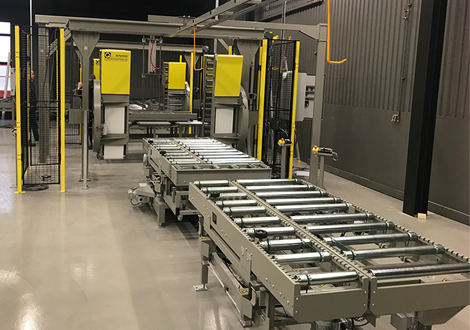
Light-duty roller conveyors are designed for transport of boxes, cartons and lighter unit loads on industrial and internal logistics environments. These systems are typically used for loads of up to 200 kg per meter, depending on the product type, support surface and conveyor configuration.
Light roller conveyors are relevant in applications where:
- Goods are relatively light and easy to handle
- The load has a stable and continuous bottom surface
- Manual or simple driven transport is sufficient
- Flexibility and accessibility are important
From a technical perspective, light-duty systems are typically configured with:
- Roller diameters around Ø50 mm
- Adjustable roller pitch depending on load size
- Conveyor widths adapted to product dimensions
- Modular sections (often around 2000 mm)
- Options for both driven and non-driven execution
Depending in the application, the conveyors can be delivered with:
- Plastic rollers for low-noise and light transport
- Steel rollers for increased durability
- Straight sections, curves and simple transfer functions
Light-duty roller conveyors are often used in packaging areas, picking zones and internal handling lines where efficient and uncomplicated product flow is required.
Building efficient material flow with integrated conveyor systems
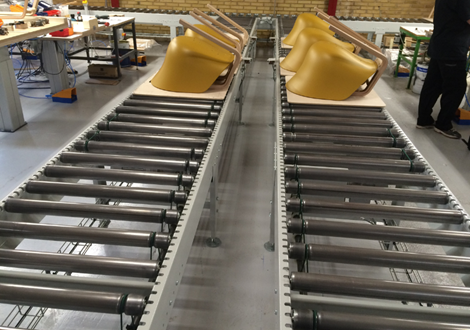
Roller conveyors are a central part of industrial material handling systems, where they support stable, efficient and continuous product flow across production and logistics operations.
When integrated correctly, roller conveyor systems help:
- Reduce manual handling and forklift dependency
- Improve throughput and overall system efficiency
- Create a more stable and predictable material flow
- Minimize bottlenecks between process steps
- Support automated handling and system scalability
This makes roller conveyors a key building block in systems where reliability and flow consistency are critical.
Depending on the layout and application, roller conveyors can be combined with:
- Chain conveyors for pallet transport, and heavy load handling
- Belt conveyors for continuous product flow and inclined transport
- Transfer cars for movement between conveyor lines and system zones
- Lifts for vertical positioning between conveyor lines
- Pallet magazines for automated pallet feeding and buffering
By combining these modules, it is possible to design conveyor systems that handle linear, lateral and vertical movement as part of a single, coordinated flow.
Roller conveyors are therefore widely used in solutions such as:
- Pallet handling systems
- Warehouse and intralogistics systems
- Production line automation
- Heavy-duty material handling systems
In these applications, the system is designed around the product, the required flow and the operational requirement, ensuring reliable performance across the entire handling process