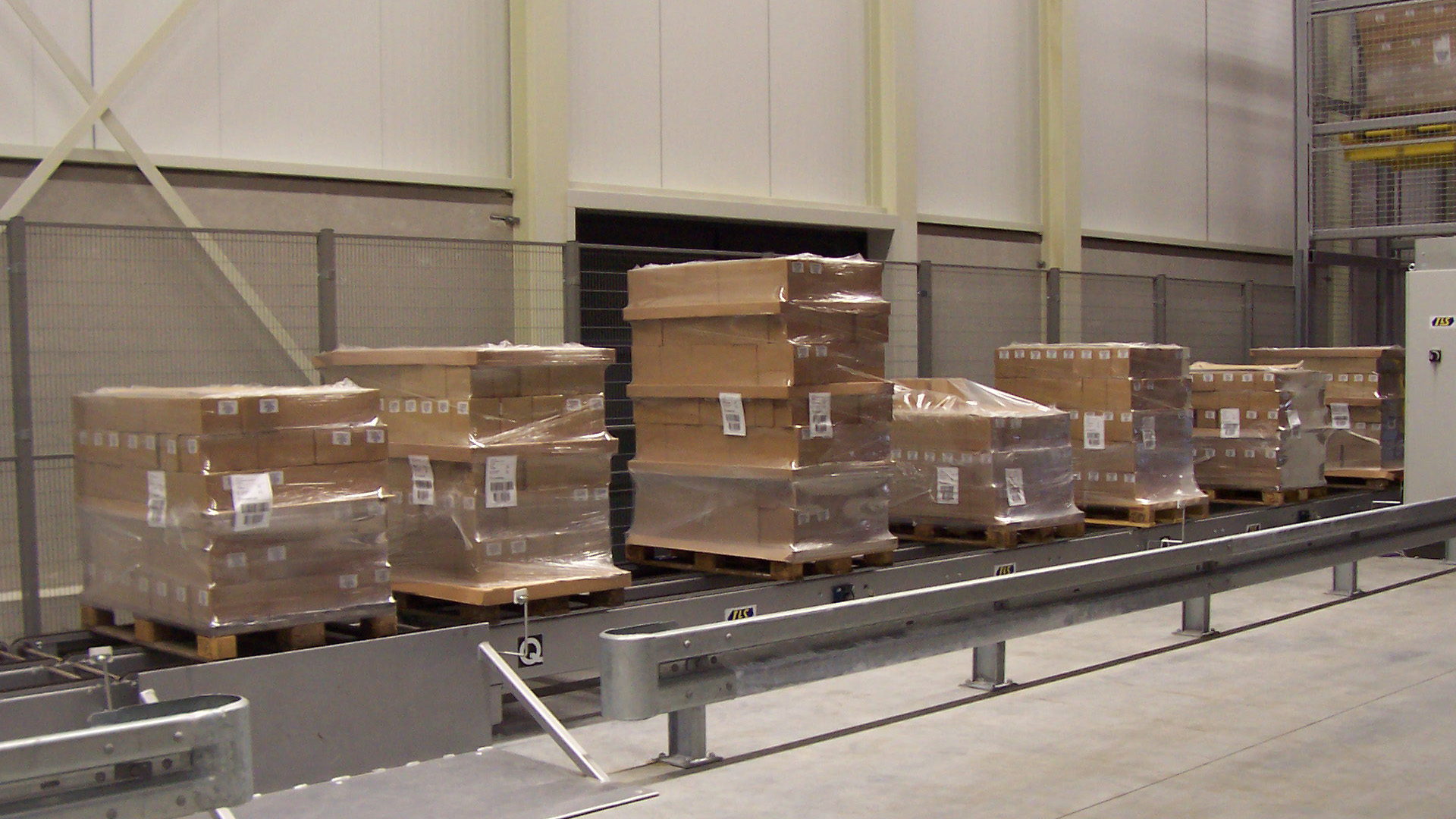
Chain conveyors for pallet transport and heavy loads
Q-System delivers chain conveyors for transport of pallets and heavy unit loads, designed for applications where the load must be supported directly at defined points during movement.
Chain conveyors for pallet transport
Chain conveyors are used for transport of pallets and heavy unit loads where the load cannot be supported across a continuous surface. The system carries the load on a limited number of chains, providing defined contact points throughout the conveyor. This makes chain conveyor particularly suitable for pallet handling where the load must be supported consistently during transport.
When chain conveyors are used
Chain conveyors are typically used in applications where the load requires defined support during transport.
This is especially relevant when:
- Pallets are transported long side across the conveyor
- The load has uneven or limited bottom support
- The product rests on specific support points
- Different pallets sizes or load types must be handled
Because the load support on chains, the conveyor supports the product based on its actual contact points rather than a continuous surface.
Direct load support on chains
A key characteristics of chain conveyors is that the load is supported directly on the chains.
This means:
- The load is carried on 2 or 3 defined support lines
- Support is determined by chain spacing and pallet design
- Contact between load and conveyor is limited and controlled
- The conveyor follows the geometry of the load
This makes chain conveyors well suited for pallets, heavy unit loads and products where the underside defines how the load must be supported.
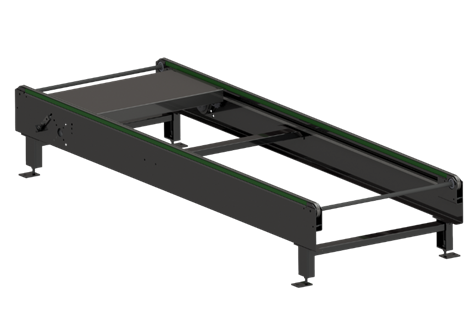
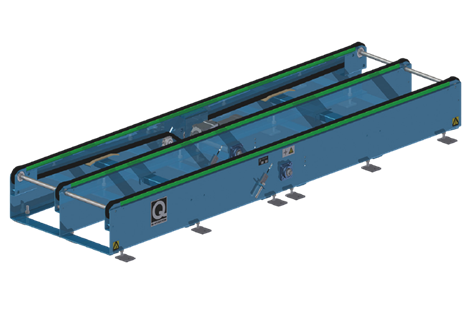
Typical chain conveyor configurations
Chain conveyors are configured based on pallet type, load requirements and system layout.
Typical solutions include:
- 2-chain conveyors for standard pallet handling
- 3-chain conveyors for wider or heavier loads
- Chain conveyors with lifting function for transfer between conveyor lines
- Integration in cross transfer systems
Chain conveyors are commonly used for horizontal or slightly inclined transport of pallets and heavy goods.
Technical design
Chain conveyors are designed based on defined load support and system requirements.
Typical parameters include:
- Number of chains and chain spacing
- Load capacity and distribution
- Conveyor width and section length
- Drive type and speed
- Integration with system controls
Typical characteristics include:
- Heavy-duty chain construction (¾" x ½")
- Robust steel frame design
- Speeds around 10 m/min
- Load handling up to approx. 1200 kg per unit load
Integrated with broader conveyor systems
Chain conveyors are rarely used as standalone units. In most applications, they are integrated into larger conveyor systems where multiple transport technologies work together.
They are commonly combined with:
This allows pallets and heavy loads to be transported, repositioned and transferred effectively throughout the system. By combining conveyor types, it is possible to design a complete material handling solution that balances stability, flexibility and throughput.
Frequently asked questions (FAQ)
1. When should a chain conveyor be used?
When the load must be supported at defined points or cannot be reliably carried across a continuous surface.
2. What loads can chain conveyors handle?
Pallets, heavy unit loads and products where the underside defines the required support points.
3. How much weight can they handle?
Typically around 1200 kg per unit load, depending on configuration.
4. Can chain conveyors be integrated with other systems?
Yes, they are commonly used together with other conveyor types in complete material handling systems.