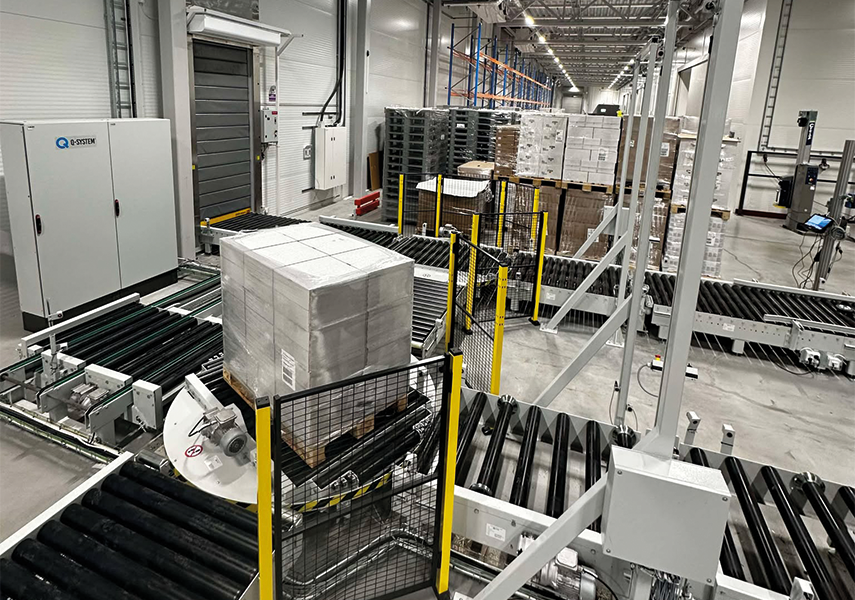
Turntables for conveyor direction changes
Q-System delivers turntables for controlled direction changes and load orientation of pallet, unit loads and products in industrial material handling systems. Designed for reliable routing and efficient system integration, they are used where loads need to be redirected or positioned correctly within the conveyor flow.
Turntables for efficient direction changes
Turntables are used in conveyor systems where products or loads need to change transport direction as part of the overall material flow. Instead of forcing the system layout into long straight transport paths, a turntables makes it possible to redirect the load within a compact area while maintaining controlled movement through the system.
Turntable are typically used where:
- The transport direction must change within the layout
- Space efficiency is important
- The system includes multiple routing directions
- Loads must be transferred between conveyor sections with different orientations
This makes turntables a valuable solution in conveyor systems where direction changes must be handled without disrupting throughput or system logic.
Change conveyor direction without breaking flow
A turntable adds rotational movement to the conveyor system. Instead of only moving products forward, sideways or vertically, the turntable allows the load to be rotated into a new transport direction while remaining part of the controlled material flow.
This is especially useful in applications where:
- Pallets or unit loads must change orientation
- Conveyor sections meet at different angles
- Compact routing is required in limited floor space
- The load needs to continue through the system without manual repositioning
By adding directional flexibility, turntables help optimize both layout efficiency and conveyor flow.
Where turntables are typically used
Turntables are used in industrial material handling systems where loads must be redirected between conveyor lines, process areas or transport paths.
Typical applications include:
- Pallet handling systems
- Direction changes between conveyor sections
- Routing between process zones
- Compact conveyor layouts with limited floor space
- Transfer between handling modules with different orientations
- Automated systems where load direction must be controlled
They are essentially relevant in layout where the material flow must remain efficient even when the transport path cannot remain linear.
Turntables for pallets, unit loads and products
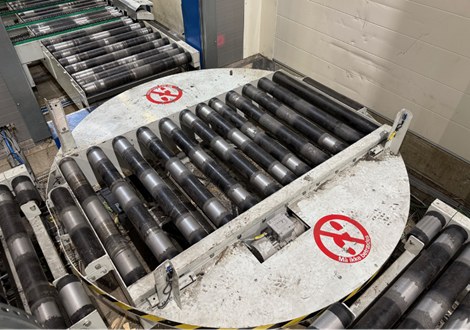
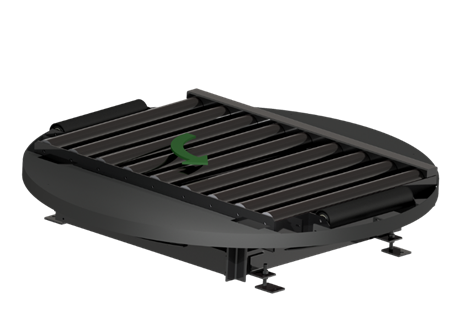
Turntables can be configured for different load types depending on the conveyor principle mounted on the turntable.
Depending on the application, a turntable may be used for:
- Pallet handling
- Heavy unit loads
- Product moving through integrated conveyor systems
- Transport flow requiring directional control between system sections
A key advantage is that the turntable can be adapted to different conveyor principles depending on the task.
Depending on the application, the turntable can be designed with:
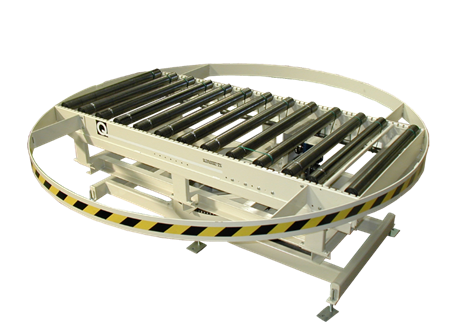
- Chain-driven roller conveyor
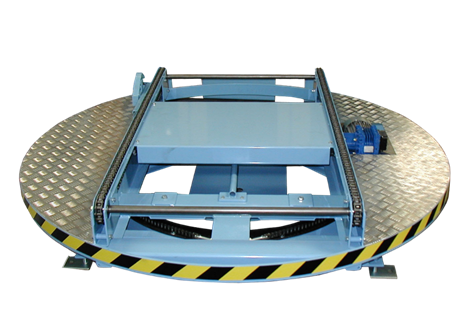
- Chain conveyor
This makes turntables highly adaptable in conveyor systems where the load type and transport principle may vary between system sections.
Designed for controlled rotation in heavy-duty applications
In many industrial layouts, a turntable is nor only a routing feature, it is a heavy-duty handling module that must perform reliably under repeated load cycles.
This is especially important in pallet handling systems where:
- Loads are heavy
- Conveyor direction changes frequent
- Stable positioning is required before onward transport
- The turntable must integrate with surrounding conveyor logic
Q-System turntables are designed for controlled rotation movement as part of the wider conveyor system, allowing loads to be redirected efficiently without compromising flow stability. Depending on the application, the turntable may be designed to support different transport angles and system routing requirements. Turntable solutions can also be configured for directional changes beyond standard 90° movement where the layout requires it.
Turntables for load orientation and scanning flow
Turntables are not only the change transport direction. They can also be used to position pallets or unit load correctly before the next step in the system.
This is especially relevant in automated material handling layouts where the load must be presented in the correct orientation for:
- Barcode scanning
- Label reading
- Downstream routing
- Storage entry
- Robotic or automated handling
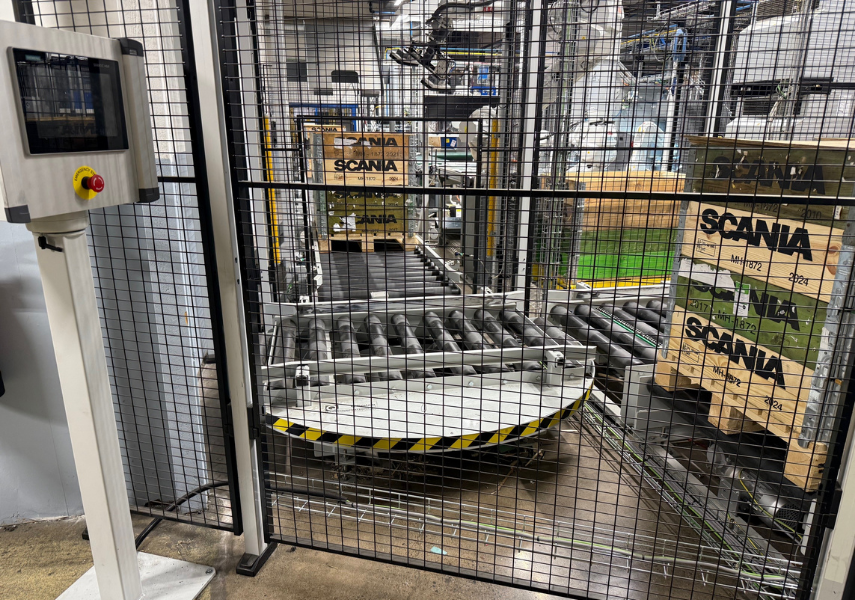
For example, a pallet may enter the system with the barcode facing the wrong direction. By integrating a turntable into the conveyor line, the pallet can be automatically rotated into the correct portion, scanned and transferred further through the system without manual intervention. This makes turntables highly relevant in systems where both transport direction and load orientation are important to the overall process flow.
Technical design options
Turntables are designed according to the load, the transport principle and the surrounding conveyor system.
Typical design considerations include:
- Load type and dimensions
- Pallet size and support requirements
- Angle of directional change Conveyor type requirements
- Drive configuration
- Integration with controls and safety systems
Depending on the application, the turntable may be designed to support:
- Directional changes between conveyor lines
- Pallet handling with controlled rotation
- Integration with roller or chain-based conveyor systems
- Repeatable positioning in industrial operating environments
Integrated with broader conveyor systems
Turntables are rarely used as standalone units. In most applications, they are integrated into a larger conveyor system where several transport principles work together across linear, cross-line and vertical flow.
They are commonly integrated with:
- Roller conveyors
- Chain conveyors
- Belt conveyors
- Transfer cars
- Lifts
- Cross transfer units
This makes turntables highly relevant in systems where loads need to move not only through the line, but also around layout constraints, process zones and routing points. In many layouts, the turntables acts as a compact routing module that helps connect the wider conveyor system.
Frequently asked questions (FAQ)
1. What are turntables used for in a conveyor system?
Turntables are used to change the direction or orientation of loads within a conveyor system. They are typically applied when pallets or other unit loads need to be rotated, redirected, or positioned correctly before continuing to the next stage of the material flow.
2. How much rotation can a turntable provide?
Depending on the application, turntables can be designed to provide direction changes from around 10° up to 270°. The required rotation angle is always defined by the layout, product flow, and downstream handling requirements.
3. Can turntables handle heavy pallets and large loads?
Yes. Our turntables are designed for heavy-duty internal material handling and can be engineered for pallets and other unit loads depending on the required dimensions, support conditions, and conveyor configuration. Examples include capacities of up to around 1500 kg, depending on the selected setup.
4. Can turntables be customized for different pallet sizes and conveyor layouts?
Yes. Turntables can be adapted to different pallet sizes, load formats, conveyor widths, and layout requirements depending on the application. They are typically integrated as part of a customer-specific conveyor system where the turntables must match both the load type and the surrounding transport flow.
5. Can a turntable be used to position pallets correctly for barcode scanning?
Yes. Turntables can be used orient pallets correctly before barcode scanning, label reading, or other identification processes. This makes it possible to present the pallet in the required direction before the next handling step and can help reduce manual turning, scan errors, and flow interruptions in automated systems.