.jpg?mw=1920&rev=91833049-8f9b-4ed8-94c1-c1d495f5496c&hash=C68956FB0C92507F1A12F064735A1570)
Transfer cars for cross-line material handling
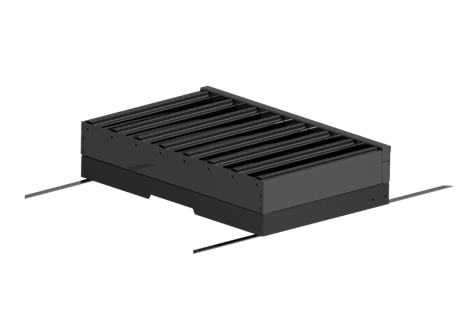
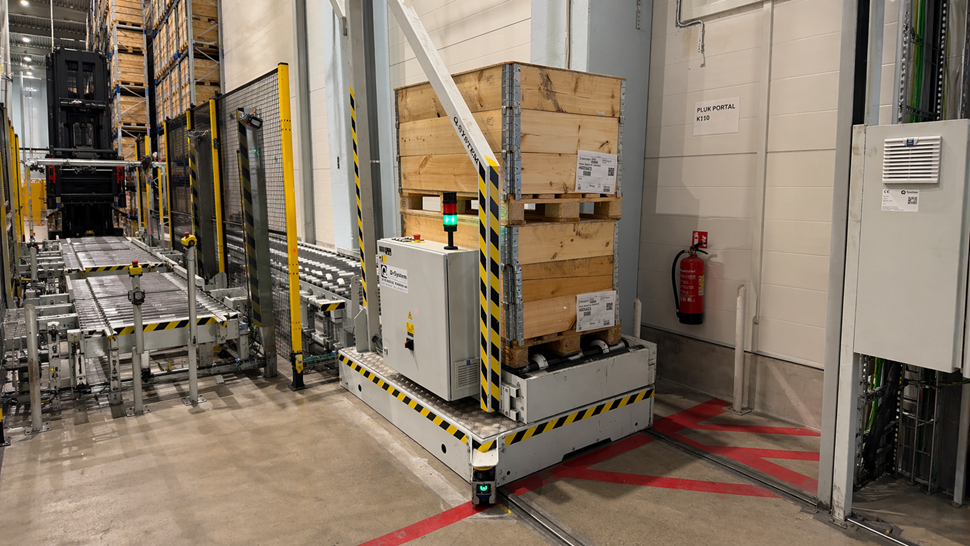
Q-System delivers transfer cars for efficient movement of pallets, unit loads and products between conveyor lines, process areas and storage positions. Designed for stable cross-line transport and flexible system integration, they are used en industrial material handling applications where linear conveyor flow alone is not enough.
Transfer cars for efficient line-to-line movement
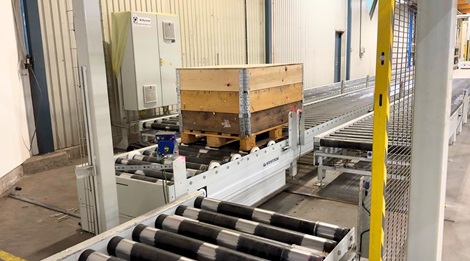
Transfer cars are used when products, pallets or unit loads need to move sideways or across defined transport routes rather than only forward through a conveyor line. They make it possible to transfer loads between parallel conveyor lines, storage positions, workstations or process zones in a controlled and space-efficient way.
Transfer cars are typically used where:
- Goods must move between conveyor lines
- The layout requires cross-line transport
- The system includes multiple loading or unloading positions
- Flexible routing is needed within the material flow
This makes transfer cars a valuable solution in conveyor systems where efficient movement between transport point is essential.
Move loads between conveyor lines and process areas
A transfer car adds an additional movement principle to the conveyor system. Instead of only moving products forward along a fixed transport path, the transfer car makes it possible to move the load laterally between selected positions in the system.
This is especially useful applications where:
- Several conveyor lines need to be connected
- Products must be distracted to multiple destinations
- Loads need to move between process zones
- Storage or buffer positions are places outside the main conveyor path
By adding controlled sideways movement, transfer cars help improve layout flexibility and make better use of available floor space.
When AGV or AMR-based transfer is relevant
In some material handling layout, mobile transfer solutions such as AGV or AMR-based systems may be relevant as an alternative to rail-guided transfer cars.
This is typically the case where:
- The transport path must remain highly flexible
- Fixed rail installation is not the preferred solution
- The system must operate across multiple dynamic routes
- Layout changes are expected over time
In these applications, Q-System can also support integrated transfer solutions in cooperation with relevant technology partners, depending on the project requirements. This makes it possible to evaluate both fixed and mobile transfer principles as part of the overall material handling design.
Where transfer cars are typically used
Transfer cars are used across a wide range of industrial material handling systems where loads must move between fixed positions or different conveyor sections.
Typical applications include:
- Transfer between parallel conveyor lines
- Pallet handling in warehouse and intralogistics systems
- Movement between production zones
- Connection between buffer areas and process lines
- Internal transport in automated conveyor systems
They are especially relevant in layouts where a traditional straight conveyor path is not enough to support the required flow.
Manual, powered and automated transfer cars
Transfer cars can be designed in different ways depending on the load, the operating environment and the level of automation required.
Depending on the application, solutions may include:
- Manual transfer cars
- Powered transfer cars
- Battery-driven transfer cars
- Transfer cars with one or multiple conveyor tracks
- Transfer cars with lifting functions
- Transfer cars with integrated turning functions
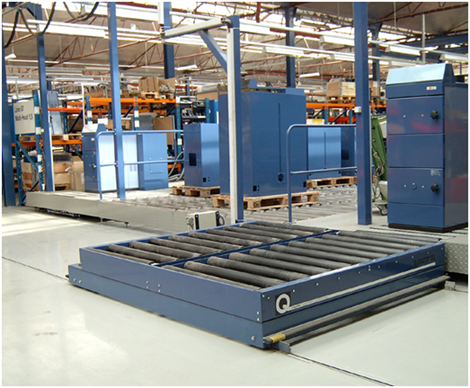
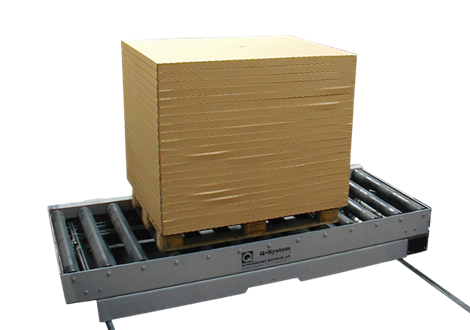
Transfer cars are used across a wide range of applications, from simple manual handling tasks to more advanced automated transport setups. This includes solutions with different drive principles, conveyor configurations, multi-track designs and integrated functions such as lifting or turning, depending on the required system functionality.
Technical design options
Transfer cars are designed based on the load, the transport route and the surrounding conveyor system.
Typical design considerations include:
- Load type and weight
- Number of transfer positions
- Track length and travel path
- Manual or powered movement
- Battery supply or cable-fed operation
- Conveyor type mounted on the car
- Lifting, turning or positioning requirements
- Integration with controls and safety systems
Depending on the application, the transfer car may be equipped with:
- Roller conveyors
- Chain conveyors
- Belt conveyors
- Turntables
- Lifting functions
- Scanners or positioning systems
This allows the transfer car to be dimensioned and configured around the actual system logic rather than treated as a fixed standard unit.
Why choose Q-System transfer cars
Q-System transfer cars are developed for industrial environments where controlled movement between conveyor lines, process areas and storage positions is required. Rather than offering a one-size-fits-all platform, Q-System designed transfer cars around the actual transport task and the surrounding material handling system.
This includes:
- Solutions adapted to the load and layout
- Support for manual, powered and automated transfer logic
- Integration with different conveyor types
- Optional lifting and turning functions
- Project-based engineering for industrial material handling
The result is a transfer car solution designed to improve flow flexibility and support efficient movement across the wider conveyor system.
Frequently asked questions (FAQ)
1. What types of load can transfer cars handle?
Our transfer cars are designed to handle a wide range of loas types, including EUR pallets (1200 x 800 mm), industrial pallets (1200 x 1200 or 1000 x 1000 mm), plastic pallets, and other customer-specific load carriers or unit loads. Depending on the application, they can also be configured for products that require controlled movement between conveyor lines, workstations, or storage positions.
2. How much weight can a transfer car handle?
Our transfer car solutions are developed for internal material handling and can be engineered based on the required load type and transport conditions. Examples include load capacities up to around 1400 kg, depending on the transfer car setup and function. Higher capacities can also be designed when required for the application.
3. When should a transfer car be used instead of a fixed conveyor layout?
A transfer car is typically used when building a full fixed conveyor connection for each route. It is often the right solution when the layout requires more flexibility, better space utilization, or controlled distribution pf product flow.
4. Can transfer cars be customized and integrated into automated systems?
Yes. All our transfer car solutions are 100% customer-specific and can be adapted to the required layout, track length, load type, transfer principle, and control setup. Depending on the project, they can also be integrated with automation systems, remote operation, sensors, and surrounding equipment as part of a larger material handling solution.